
Biologics & Wedges
Treace™ Allograft Wedges Engineered for Strength & Correction
CortiFuse™ Maximizing Healing Potential with Every Fiber

Treace™ Allograft Wedges
Ready to Use
Prehydrated in sterile saline eliminates intraoperative preparation
Reliable Strength
Every lot tested to meet compressive strength requirements1
Preshaped Grafts
Uniquely designed to facilitate desired correction


Lapidus Allograft
Wedges
2-degree design facilitates plantarflexionand intermetatarsal angle correction.2

Cotton Allograft
Wedges
Pre-sized and designed for Cotton osteotomies.

Evans Allograft
Wedges
Pre-sized and designed for Evans osteotomies involving lateral column lengthening.

MTP Allograft
Wedges
Cup and cone design compatible with Treace™ reamers.2
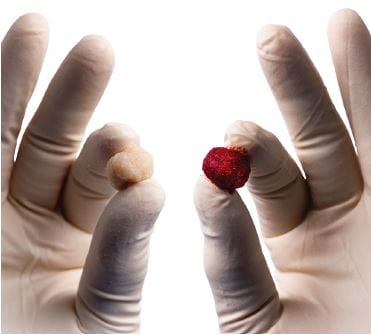
CortiFuse™ Flowable
Cortical Fibers
Flowable & Moldable
Cortical microfiber strands provide a homogenous, flowable, and moldable allograft that handles like a putty
Osteoinductive Potential
Process validated to preserve the osteoinductive potential of the bone matrix*
Composition
Composed of 100% lyophilized cortical fibers enabling hydration in blood, BMA or saline


Supporting Documents
Treace™ Allograft Wedges Sales Sheet
CortiFuse™ Sales Sheet
Got Questions?
For more information or to get trained on Treace’s comprehensive 3D Bunion Correction® systems, give us a call or complete the form.
1. *Minimum compressive strength criteria is set at 3 MPa. Berkeley Advanced Biomaterials data on file.
2. TMC Data on File
*Origin Biologics Data on File. Final product was tested via an in vivo model.
Before use of the allograft tissue, the surgeon should refer to the appropriate instructions for use for complete warnings, precautions, indications, contraindications, and adverse events. See the product labeling for instructions for use and other important information from the respective manufacturer, Berkeley Advanced Biomaterials or Origin Biologics. Risks include, but are not limited to: improper response with adjacent tissue (e.g. fusion/union), infection, allograft rejection, deformity of the bone at the site, inflammatory or immune response, and potential for transmission of infectious agents. If any of these occur, additional treatments may be needed. It is the surgeon’s responsibility to inform patients of the risks of this product and any surgery in which it is used and the importance of following the surgeon’s post-operative protocol. Additional information about risks, warnings, and instructions can be made available by Treace Medical Concepts, Inc. at 904-373-5940 or cs@treace.net
M3938A